bio-pak

How Do Enzyme RV Tank Treatments Benefit Your Holding Tank?
How Do Enzyme RV Tank Treatments Benefit Your Holding Tank?
Quick Answer: Enzyme-based RV holding tank treatments speed up the breakdown of waste and toilet paper, helping prevent clogs, reduce odors, improve dumping efficiency, and keep tank sensors functioning properly.
What Are Enzymes and How Do They Work in RV Tanks?
Enzymes are naturally occurring proteins that act as catalysts, meaning they accelerate specific biological reactions. In an RV black or grey holding tank, enzymes help digest organic waste and toilet paper more quickly and efficiently.
Once added to the tank, enzyme formulas begin working immediately to liquefy solids and reduce the buildup that can accumulate on tank walls and sensors.
How Do Enzyme Treatments Prevent Clogs?
By breaking down waste and paper into smaller, more fluid particles, enzyme treatments help prevent:
- Pyramid buildup
- Paper accumulation
- Slow drainage
- Restricted flow during dumping
This improved digestion makes it easier to empty the tank completely when it reaches about two-thirds full.
Do Enzyme Tank Treatments Control Odors?
Yes. Odors often originate from undigested organic material inside the tank. Enzymes help neutralize odors by accelerating the decomposition of waste rather than simply masking smells.
Can You Use Regular Toilet Paper with Enzyme Treatments?
Many RV owners purchase specialty RV toilet paper to prevent clogs. However, a high-quality enzyme-based formula is typically powerful enough to digest standard household toilet tissue, eliminating the need for special paper.
Which Types of Enzyme Products Are Available?
There are several types of enzyme-based RV treatments, including:
- Black tank deodorizer and digester – For routine odor control and waste breakdown (e.g., Bio-Pak).
- Deep-clean black tank treatment – For removing hardened buildup and restoring sensors (e.g., Commando).
- Grey tank deodorizer – For breaking down grease and organic sludge in sink and shower tanks (e.g., Elemonate).
Why Product Quality Matters
Not all enzyme formulas are created equal. Higher-quality treatments are engineered for faster activation, stronger digestion, and consistent performance across varying climates and usage levels.
Bottom Line
Enzyme-based RV tank treatments improve digestion, reduce odors, prevent clogs, and help maintain accurate sensors—making them a smart choice for routine holding tank maintenance.
Happy Adventuring!


4 Essential Products to Keep Your RV Odor-Free and Clean
4 Essential Products to Keep Your RV Odor-Free and Clean
Quick Answer: To keep your RV free from odors, grease, and buildup, you need four essentials: a multi-purpose exterior cleaner, a black tank deodorizer, a grey tank treatment, and an air odor absorber.
Why RV Odor Control Requires More Than One Product
RVs have multiple odor sources: the black holding tank, grey holding tank, cooking areas, pets, and exterior grime. Using targeted products for each area prevents lingering smells and keeps your RV clean inside and out.
1. Multi-Purpose Cleaner for Deep Cleaning
A space-saving, multi-function cleaner is essential for RV living. A 3-in-1 cleaner and degreaser can handle:
- Rubber roof cleaning
- Awning cleaning
- Black streak removal
Products like Green Hornet are available in ready-to-use spray or super-concentrate formulas, allowing you to dilute based on cleaning intensity. This versatility saves storage space while covering multiple cleaning needs.
2. Black Holding Tank Deodorizer
The black tank is the most obvious odor source in any RV. A high-quality deodorizer that also digests waste is essential.
Bio-Pak combines odor control with natural enzyme digestion. The formula breaks down waste and toilet paper, helping prevent clogs and buildup while keeping odors under control. It is septic-safe and environmentally friendly.
3. Grey Holding Tank Treatment
Grey tanks collect water from sinks and showers. Over time, grease, soap residue, and organic sludge can build up and create unpleasant smells.
Elemonate is designed specifically for grey tanks. Simply drop one tablet into the sink and run water briefly to dissolve it. The enzymes work to break down grease and grime while leaving behind a light lemon fragrance.
4. Air Odor Absorber
Even after cleaning tanks and surfaces, airborne odors from cooking, pets, or travel can linger. An air neutralizer helps eliminate remaining smells at the molecular level.
Odor Absorber is a charcoal-infused gel that begins neutralizing odors as soon as it’s opened. It can freshen up to 300 square feet for up to 60 days. Available in subtle scents like lavender and orange twist, it’s ideal for travelers sensitive to strong fragrances.
Complete RV Odor Control Checklist
- Clean exterior surfaces regularly
- Treat black tank after each dump
- Maintain grey tank to prevent sludge buildup
- Use an air neutralizer for lingering smells
Bottom Line
Effective RV odor control requires a complete system—not just one product. With the right cleaner, tank treatments, and air neutralizer, you can travel comfortably without unwanted smells.
Happy Adventuring!
RV-ers Test & Review Walex Products
We love when RV-ers call or email us with honest feedback after using our products. We get a lot of positive reviews, which is great, but we also value constructive criticism because it helps us improve existing products or introduce new products to the market. Here's a fantastic, detailed review we recently received. If you're currently using Walex products, tell us what you think! Call 910-371-2242 or email RV sales manager Tony Butler.
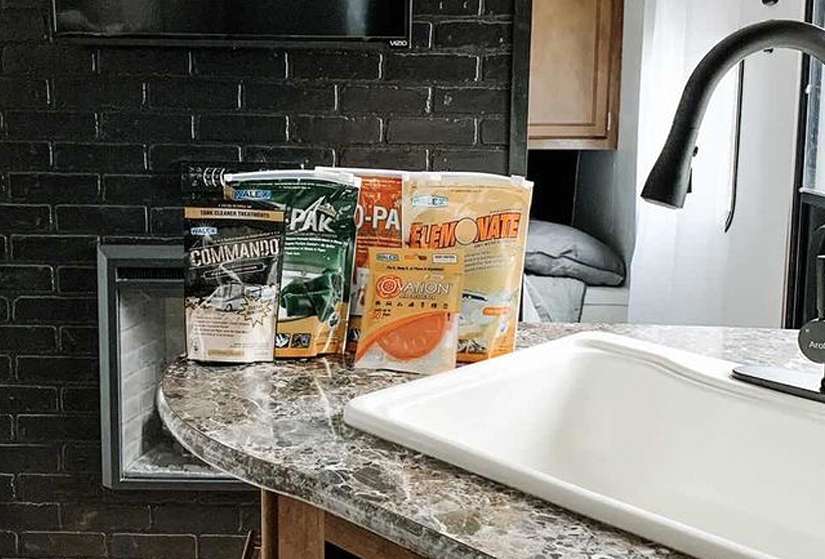
Charles uses Porta-Pak, Bio-Pak and Elemonate. Here's his experience with the products so far:
Hi Tony, I wanted to follow up with you on our winter and spring camping experiences with Walex products in our two RVs.
Our continued winter experience with bio-pac in our holding tank for our travel trailer was excellent, no smells and good breakdown. I was concerned that the cold temps would inhibit essential bacteria growth and hinder breakdown, but all was well!
In our small off-road pop-up camper’s cassette toilet, the porta-pac kept smells very manageable, but I do think that the bio-pacs do a better job in the cassette toilet as well for odor management. I was concerned that the small cassette tank would not afford enough time for the essential bacteria to work, but bio-pac seems to have performed well at breakdown and superior in odor management.
Now that the temps are warming up, I will keep tabs on changes in performance characteristics. Our small off-road camper turns in a hot box in the summer when we close it up for the day to go hiking, etc. I will be curious to see if we need to switch to porta-pac for that one. Of course, I will follow up with you on that.
The elemonate did remove the tendency for grease to buildup on our dump valve, which is a huge plus. I noticed that change on first application. However, the sensor in that tank still wants to stick and I have no idea if that is a sensor issue, or a grease / containments issue. Do you think two tablets would be better, or maybe a time in tank issue? We typically have to dump the galley gray every other day. I do use elemonate every dump cycle.
I hope my info and feedback helps and my goal of giving you all a year of real world feedback will conclude at the end at the summer. It has been a fun side camping project for me and we all gain in the end. I will let you know how things go over the summer we wrap it up and see what we learned!

Can I use Porta-Pak or Bio-Pak in my yacht's holding tank?
Keeping your yacht's toilet clean and odor-free
If you own a sailboat, yacht, or other vessel that has a toilet and you want to prevent or eliminate unpleasant odors, Walex has the solution.
You can use either Bio-Pak or Porta-Pak in your boat's holding tank. Walex's RV holding tank deodorizers are also designed for marine use.
Walex's R&D department recently tested Porta-Pak and Bio-Pak in saltwater since some yacht owners use seawater to flush their toilets. We found only a slight slowdown in enzyme digestion in Bio-Pak, and it still dissolved the toilet paper.
Usage of drop-in deodorizers is the same in RV toilets and yacht toilets. After dumping, start with one packet of product and 1.25 gallons of water for every 10 gallons of holding tank. Five gallons of water will let the waste and paper fall below the waterline, allowing the product to go to work controlling odors.
Happy Adventuring!
How Often Should You Add Deodorizer to Your RV Black Tank?
How Often Should You Add Deodorizer to Your RV Black Tank?
Quick Answer: Most RV owners should add one drop-in deodorizer packet every time they dump their tank—typically every 5–7 days for two people in moderate weather. Always add treatment immediately after emptying and refilling the tank.
How Long Does One Bag of RV Deodorizer Last?
Usage depends on how many people are using the RV and how frequently the tank is dumped. As a general guideline:
- Two people in moderate temperatures: 1 packet every 5–7 days
- Higher usage or warmer climates: possibly more frequent treatment
- Lower usage: slightly longer intervals
If a bag contains 10 packets, it typically lasts about 5–10 weeks depending on usage.
When Is the Best Time to Add RV Tank Deodorizer?
The ideal time to add a new packet is immediately after dumping your black tank. Waiting until the tank reaches about 2/3 full before dumping ensures strong flow, which helps remove solids more effectively.
For enzyme-based treatments like Bio-Pak, allowing the tank to reach 2/3 full gives enzymes more time to liquefy waste and paper for easier dumping.
How Much Water Should You Add After Dumping?
Water is critical for odor control and proper digestion.
Recommended starting point:
- 1.25 gallons of water per 10 gallons of tank capacity
For a 40-gallon tank, that equals about 5 gallons of water before use.
Proper water levels allow waste and paper to sink below the waterline, where treatment works most effectively. Insufficient water can lead to hardened buildup (often called a pyramid plug) and persistent odors.
Why Sensor Accuracy Affects Odor Control
Knowing when your tank is 2/3 full depends on functioning sensors. If your sensors give false readings, you may dump too early or too late, which can affect odor control and tank health.
If sensors become inaccurate, use a deep-clean treatment like Commando to remove residue from tank walls and sensor probes.
How to Restore Sensor Function
- Empty the tank.
- Add one Commando packet.
- Fill the tank above sensor level.
- Let sit for 12–24 hours (longer if needed).
- Dump and rinse.
This process helps liquefy residual buildup, lubricate valves, and restore accurate readings.
Best Practices for Odor-Free RV Travel
- Dump at 2/3 full
- Add deodorizer immediately after dumping
- Use adequate water
- Monitor sensors regularly
- Perform periodic deep cleanings
Bottom Line: Consistent treatment, proper water levels, and accurate sensors are the keys to keeping your RV toilet odor-free.
Happy Adventuring!
Should I Get a Performance-Driven or a Natural Enzyme RV Tank Treatment?
Performance-Driven vs. Natural Enzyme RV Tank Treatments: Which Is Right for You?
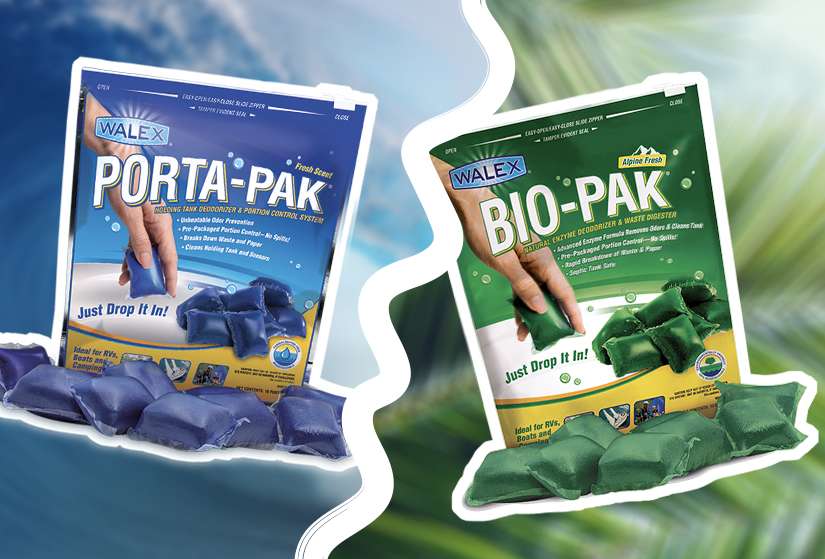
Quick Answer: A performance-driven formula like Porta-Pak typically delivers powerful odor suppression in extreme heat and high-demand conditions, while a natural enzyme formula like Bio-Pak excels at digesting waste and toilet paper to prevent clogs, buildup, and septic disruption. The best choice depends on your climate, dumping method, and maintenance priorities.
What Is a Performance-Driven RV Tank Treatment?
A performance-driven holding tank formula is engineered for maximum odor defense. These treatments focus on stopping odor at its source and delivering strong, reliable results—especially in hot weather when odors intensify quickly.
They are often preferred in:
- High-temperature climates
- Heavy-use situations
- Extended camping trips
- Applications where rapid odor control is the top priority
Because heat accelerates odor production, a performance-driven formula can provide consistent protection in demanding environments.
What Is a Natural Enzyme RV Tank Treatment?
A natural enzyme formula works differently. Instead of simply suppressing odor, the specific enzymes target odor molecules, paper and waste. Enzymes act as catalysts that digest solids and odor molecules, helping maintain a cleaner, odor-free tank environment.
This approach helps:
- Liquefy toilet paper
- Prevent pyramid buildup
- Reduce clogs
- Keep tank walls and sensors cleaner
- Support septic system compatibility
Which Formula Is Better for Preventing Clogs?
If your primary concern is preventing paper buildup, hardened waste, or inaccurate sensor readings, a natural enzyme formula typically provides better long-term digestion and tank cleanliness.
Which Formula Performs Better in Hot Weather?
In very hot climates, a performance-driven formula may deliver stronger immediate odor suppression. Higher temperatures can intensify odors quickly, making advanced odor-control technology especially beneficial.
How Do You Choose the Right RV Tank Treatment?
Consider the following factors:
- Your typical camping climate
- How frequently you dump
- Whether you dump into a septic system
- Your history of clogs or sensor issues
- Campground or state disposal regulations
Many RV owners use a natural enzyme formula for routine weekly maintenance and incorporate a stronger cleaning treatment periodically to deep clean the tank.
Bottom Line
If you camp in extreme heat and want maximum odor defense, a performance-driven formula may be the better fit. If your focus is digestion, clog prevention, and septic compatibility, a natural enzyme formula is often the smarter long-term solution.
Need Help Deciding? Call 800-338-3155 for expert guidance on selecting the right holding tank treatment for your RV lifestyle.

Can I use regular toilet paper in my RV toilet?
Do You Really Need Special RV Toilet Paper?
Quick Answer: RV toilet paper is designed to dissolve quickly in holding tanks, but it is not always necessary if you use an enzyme-based RV tank treatment that breaks down regular toilet paper effectively.
Why Is RV Toilet Paper Different?
Unlike home plumbing systems that move waste directly into municipal sewer lines, RV toilets flush into a holding tank where waste and paper remain stored until dumping. RV and marine toilet paper is manufactured to dissolve rapidly to reduce solid buildup inside the tank.
The goal is to minimize clogs and make dumping easier at campground stations.
Is RV Toilet Paper Required?
No. While RV toilet paper can help reduce buildup, it is not mandatory if your holding tank is properly maintained. The key is ensuring that waste and paper break down efficiently inside the tank.
How Can You Use Regular Toilet Paper in an RV?
Using a high-quality enzyme tank treatment allows many RV owners to use standard household toilet paper without issues. Enzyme formulas are designed to digest paper and organic waste, reducing the risk of clogs and buildup.
Which RV Tank Treatments Break Down Toilet Paper?
Bio-Pak is a weekly drop-in deodorizer that uses enzymes to digest waste and paper while controlling odors. It is available in Alpine Fresh and Tropical Breeze fragrances.
Commando is a deep-clean black tank treatment designed for periodic use. It helps remove hardened buildup from tank walls and sensors, which can interfere with level readings and valve performance.
What Happens If Toilet Paper Builds Up in Your Tank?
- False sensor readings
- Persistent odors
- Slower drainage
- Potential clogs
- Difficulty emptying completely
Routine enzyme treatments help prevent these issues by keeping solids liquefied and tanks flowing freely.
Best Practices for Healthy RV Holding Tanks
- Use plenty of water with each flush
- Dump when the tank is about 2/3 full
- Use enzyme-based tank treatments regularly
- Perform occasional deep cleanings
Bottom Line: RV toilet paper can help, but consistent tank maintenance with enzyme-based treatments plays a much larger role in preventing buildup and keeping your system operating smoothly.
Need Help Choosing a Product? Call 800-338-3155 for expert guidance.
Are holding tank treatments safe for septic tanks?
Are RV Holding Tank Treatments Safe for Septic Systems?
Quick Answer: Some RV holding tank treatments are septic-safe, while others can harm your septic system. If you dump your RV black tank into a home septic system, you should use an enzyme-based, biocide-free treatment that supports healthy bacteria instead of killing it.
Why Does Septic Compatibility Matter?
Septic systems rely on naturally occurring bacteria to break down and digest waste. These beneficial bacteria are essential for proper system function. If you introduce harsh chemicals that kill bacteria, your septic system may struggle to process waste efficiently, potentially leading to backups, odors, or long-term damage.
Do Some RV Tank Treatments Harm Septic Systems?
Yes. Certain sanitation products control odor by suppressing or killing bacteria inside the holding tank. While this may reduce smells temporarily, it can disrupt the biological balance inside a septic system if you dump treated wastewater at home.
Repeated exposure to bacteria-killing chemicals can weaken septic performance over time.
What Makes an RV Tank Treatment Septic-Safe?
Septic-safe treatments typically use natural enzymes or beneficial biological agents rather than harsh biocides. Enzymes act as catalysts that help break down waste and toilet paper without harming the beneficial bacteria your septic system depends on.
How Does Bio-Pak Support Septic Systems?
Bio-Pak controls odor using natural enzymes that digest waste and paper inside the holding tank. Instead of disrupting bacterial activity, these enzymes are compatible with existing septic microflora and help promote healthy digestion within the system.
The formula is designed to address common malodors caused by sulfides, amines, and ammonia while remaining free of harsh biocides and formaldehyde.
Who Should Use Septic-Safe RV Treatments?
- RV owners who dump into home septic systems
- Campers staying on private property
- Travelers who alternate between dump stations and home disposal
- Anyone concerned about protecting septic health
How to Choose the Right RV Tank Treatment
If you frequently dump into a septic system, look for products labeled:
- Biocide-free
- Formaldehyde-free
- Enzyme-based
- Septic-safe
Choosing the correct formula protects both your RV holding tank and your home wastewater system.
Need Help Deciding? Call 800-338-3155 for guidance on selecting the right holding tank treatment for your dumping setup.